03 June 2011

sikkim: where nature smiles


I was to be released from my project AXA Belgium Life Retail ULIS on 28th March, 2011 where I had tirelessly and fruitlessly served for two years and presently had nothing much to do. A trip to Sikkim had been immediately planned after returning from the trip to Darjeeling in December, 2010. I was a bit disillusioned and low but nevertheless was firm on continuing with the tour.

My partner was yet again Vivek Shrivastav at whose home I spent the night of 25th March, 2011. We got up early the next day and unlike the last time when we had to leave for New Jalpaiguri (NJP) and we got a taxi even before day-break, today was a bit different. We had to walk right till Belurmath but still no taxi was ready to go and the one which agreed wanted a month of our salary. We instead took a bus full of enthusiastic passengers. It was a Saturday morning and pilgrims in huge numbers were on their way to the temple of Dakshineshwar from where we had to take our train. It was a ludicrous morning and with a jam-packed bus, reluctant to move and busy picking up passengers and the clock ticking fast, we ultimately and nervously reached the station. Our train was quite on time and by the time we reached NJP it was already dark.

We booked a hotel (Hilton) and decided to leave for Gangtok early the next day (26th March). The hotel was pretty good and the weather relatively pleasant. We altered between Set Max that was showing the first semi final match of 2011 ICC Cricket World Cup between Sri Lanka and New Zealand and Zoom where pretty and suave girls were being trained for the Miss India 2011 contest. Sri Lanka was comfortably placed to win and one of the girls Kanistha Dhankhar who made our hearts skip a beat actually went on to win the title a couple of weeks later when the actual contest was held. We had dinner at a nearby restaurant and after some planning retired for a good night’s sleep.

going to sikkim

Early the next day we got up and started scouting for a shuttle that would take us to Gangtok but as fate would have, we unfortunately landed in a tour operator’s office (what was the name?). We had planned and executed bigger trips earlier and the entire itinerary was clear this time. We had both time and money and were averse to any idea of a tailor-made trip but for reasons unknown (maybe laziness) we went ahead with what the tour operator (Vivek Das) said. We told him everything we had in our mind. We wanted to go to Gurudongmar, Tso Lhamo, Tso Mgo and Nathu La besides Gangtok of course. Mr Das exclaimed with a sigh that Gurudongmar would be impossible and expensive considering we were just two and we instead plan for Yumthang Valley. He also said that shuttles don’t ply till Gurudongmar which I later found was absolutely false.Though I had extensively read on places to visit in Sikkim but this being my first visit to the state and without any contact with a local I assumed the operator would know better and agreed to whatever he said. We were to pay close to Rs 9,000 for the two of us which included a drop till Gangtok, lodging at a hotel (Himalayan View) near M G Marg, local sightseeing for a day, a 2 day and 1 night trip to Yumthang valley via Lachung (fooding and lodging included) and a trip to Nathu La and finally, a drop till NJP on 31st March. The whole thing sounded good and after the payment was done we left for Gangtok.

It was yet again a pleasant journey through NH 31 following Siliguri, Mahananda Wildlife Sanctuary (MWS) and Sevoke and then through NH 31A following Teesta Bazaar (where we had our breakfast), Melli (they had a check post on the West Bengal-Sikkim border town to check the identity of tourists), Rangpo, Singtam, Ranipool, Upper Tadong and finally Gangtok. The river Teesta was amazing and accompanied us all throughout the journey. The area bypassing MWS and around Sevoke was the most stunning in the entire journey. The river was wide, the roads smooth and clean, the hills ever rising and thickly forested and giving way to the tiny yet beautiful state of Sikkim. We reached our hotel sometime in the noon. The room was quite ok but not like the tour operator had shown in the photographs (expectedly so). Gangtok is a nice little city with curvy roads going up and down. The journey of visiting hill towns started with Shillong in December, 2009 and since then I have been to so many including Bomdila, Tawang, Darjeeling and now Gangtok. Gangtok is the capital of Sikkim and comparatively larger than either of what I had seen earlier. It was also at a relatively lesser height except for Shillong. We had to submit our identity documents and some photographs for the passes to Yumthang Valley and Nathu La. Gangtok was quite expensive a city and everything except alcohol came for a dearer price.

mahatma gandhi marg

We decided to have a reconnaissance of the area where we were staying. M G Marg was nearby and is often considered to be one of the melting points of tourists and locals in the city. It was a fascinating street with a rich colonial look. Buildings with architectural details reflecting both traditional and modern look lined the street on both sides and Victorian street lamps and a trail of flowering plants formed a boundary in the middle. The place had a cinema hall, numerous alcohol shops, restaurants, shopping centers, cafes, book stores and almost everything one could imagine. It was a good place to hang out with friends and observe people of the town. We had our lunch at the hotel (good but definitely not worth the price) and decided to go for local sightseeing. Our car was pre-booked and the driver showed us a park which had a flower exhibition center nearby (which we didn’t not visit for obvious reasons).

drodul gompa

He also showed us the Drodul gompa, the White Memorial Hall, the State Legislative Assembly and within a matter of an hour or so dropped us near the ropeway. Since it was a Sunday the ropeway was closed and moreover it was nonoperational for quite a few days owing to repair. We couldn’t go to the zoo since it was higher up in the city so we decided to have a decent view of the city from Suicide Point near the ropeway. It was quite a walk up and down the place but worth every bit. It started raining by the time we reached M G Marg again so we stopped at a bakery and couldn’t stop from indulging in some sinful pastries (fresh and aromatic) and then moved on to spend some quality adda time at Cafe Cacao, a brilliant place with a view of the street bustling with activity and good-looking girls serving Cappuccino and Mocha. We had countless pegs of alcohol later in the night and after a couple of stints on M G Marg where we met a tourists from Netherlands (Hugo de Vries) we were off to sleep.

a park in gangtok

The next morning (28th March) we waited for a while before we could take our shuttle for Yumthang Valley. It was already noon by the time we were ready to leave. We were accompanied by a couple of Bengali families in our car. One was a group of five (mom, dad, a minor son and grandparents) from Asansol and another of three (mom, dad and a minor daughter) from Kolkata. The gentleman from Asansol was seemingly pleased with us making a trip in a group of two. He was quite the age of my dad but much more enthusiastic. His wife and parents were somber as were the other family and their daughter but this gentleman was apparently on cloud nine. Vivek and I took the front seat beside the driver.

white memorial hall

We halted at the outskirts of Gangtok to buy some packaged food because the place we would halt for the night, the small town of Lachung, had precious nothing. Our driver was a young man and not before long we became friends for the entire journey. It was getting colder as we went higher and higher. My heart skipped another beat when we finally entered the district of North Sikkim, often called the Switzerland of India by local tour operators, though I am strictly against such comparisons. The district was markedly beautiful with numerous streams, waterfalls, valleys, cliffs and precarious road at every turn. On one hand we had our driver who constantly kept us telling stories of tourists from India and the world across and on the other we had Mr Ganguly of Asansol who kept us asking questions ranging from tourism in India to how it was working in an IT firm. It was definitely engrossing and enriching.

at a park in gangtok

The driver said that the bulk of tourists come from West Bengali and that Bengalis in general were good but terribly cribbing. He disliked Marathis and Gujaratis who he thought were too shrewd for the people of the hills. Among the foreigners he held people from Brazil, USA, Netherlands and UK in high esteem while the very mention of Israel or South Africa made him angry. The constant gibber continued but I still managed to sneak a view out of the window and admire nature at its best. It was a thrilling experience driving in the mountains and they never fail to charm.

view of gangtok from suicide point

Not before long we came across our first halt at the Seven Sisters Falls. It was exotic but terribly crowded with tourists and to add to the agony it was raining. We got some shots and had tea and pakora. It was a sinful delight to be amidst such lustful greenery and heavenly beauty. We continued towards Lachung but sections of bad road and a faulty engine made our journey not with its share of hiccups. We had lunch at a small eatery in Namako where the Ganguly family got into a fight of sorts with the owner for not serving him properly and adequately and asked if he looked like a beggar to be deserving such a treatment. After the drama got over we continued on our journey but the driver soon stopped beside a huge terraced hill to fill the tank with petrol (or was it diesel?)

seven sisters falls

Finally we reached Mangan, the district headquarter of North Sikkim where our permits to enter the place beyond were scanned. The place is commonly known as the Large Cardamom Capital of the World but that was of little joy for hapless tourists whose vehicle kept crashing every second hour. This time the driver decided to fix the car for good because beyond that place there was no town worth the name where things could get fixed and moreover it was getting dark and we were pathetically behind schedule. We had tea, fruit cakes, peanuts and biscuits to kill time but the driver kept on doing what not with the engine. Finally after an hour or so we again set for Lachung, our destination for the day. We soon crossed a bridge which the driver told was the third highest in Asia (perhaps true on later research) and reached Tung.

The driver told that beyond this place the state government didn’t have much of jurisdiction since the locals were terribly autonomous. I didn’t know how much of that was true but the place certainly looked deserted, surreal and ghostly. There were a couple of check posts maintained by ITBP and except that there was no sign of habitation for miles to come. It was one of the most fascinating places in the entire journey. The place had huge vertical cliffs dropping into the valley where the mighty Teesta flew with all its glamour and turbulence. I could see mighty waterfalls dropping into the valley but the car was speeding more than ever. We passed across some more enormously huge falls but nowhere could we stop and take photographs and inquire further. It was quite dark by the time we reached Chungthang, the place from where another road leads to Lachen and finally the much sought after destination of Lake Gurudongmar but we had to head straight for Lachung.

Chungthang was enveloped in darkness except for a huge expanse of land where a 1200 MW hydroelectric power plant (Teesta stage III) was coming up. We had some tea and cookies at a small tea stall and headed for Lachung before it grew any colder. The roads were assumingly more dangerous because we crossed 2000 m moments later and in a matter of half an hour or so would cross 3000 m but nothing seemed to bother us in the darkness of the night. The Ganguly family kept on reminding the driver to drive slow. They didn’t mind reaching late for dinner but wanted to reach safe. We did surely reach safe and the hotel where we stayed (what was the name?) was much like a cottage with tiny little rooms without locks. Lachung is a place where none of the homes, even hotels, have locks from outside and this was particularly amazing to discover. India is truly incredible!

naga falls

We discussed the plan for the next day with the families accompanying us and the driver and bid him a bye. Our trip was supposed to be till Yumthang Valley but the driver insisted on showing Zero Point - a few miles further north which was at a height greater than 4000 m and full of snow (as if that would excite me even a bit more). I knew we were getting duped but still thought of paying him some extra bucks to take us till the point. We had a talk with other fellow tourists from faraway places including Punjab and Andhra Pradesh, had our dinner (where again the Ganguly family cried hoarse on not being served adequate and properly) and retired to bed but not before gulping a few shots of white wine, locally made in the vineyards of Sikkim.

morning view form our cottage at lachung

We had a comfortable sleep and woke up the next day with Vivek exclaiming in utter disbelief and excitement, “Vivek, look outside.” And it was indeed a beautiful view. I didn’t have my contact lenses on so I hurried up, washed my face and went out in just a vest and my specs. It was one of the most beautiful days I had woken up to. The comfortable chill in the air, the tiny little town with a winding road, exotic and towering peaks covered with snow all around. It couldn’t get any better. We dressed ourselves up and headed for Yumthang Valley with our gum boots on (they are bloody uncomfortable). We crossed an army camp (beautiful, clean and neatly maintained as always) and crossing a road moving upwards along rhododendrons eager to bloom and with snow-capped peaks wherever we saw up we came to Yumthang Valley. We had some tea but prior to that an encounter with knee-deep snow left me (or for that matter my legs) totally numb.

yumthang, north sikkim

We decided to see Zero Point first and then Yumthang Valley. The driver had told the place was some 25 km north of the valley and the actual source of river Lachung, one of Teesta’s headwaters but we couldn’t reach the place owing to heavy snowfall the previous night which had blocked the road. We nevertheless halted where the road was blocked, walked a few miles and came back when our quench for snow, Himalayan peaks, trees laden with snow and unparalleled beauty was filled to the brim. We had Magi cooked in snow picked from the road and headed for Yumthang Valley. The roads were bad and we had to halt at a couple of places.

yumthang, north sikkim

The valley was awesome. On one side we had the mighty Himalayas with glaciers flowing down them and on the other river Lachung. We hurried our steps and reached the river. You feel amazed that a river so big and turbulent down in the plains was so quiet and tiny here. The water was crystal clear and the bed rocks pleasantly visible and despite being biting cold we thought of crossing it with our gum boots on. Mr Ganguly and family (minus the grandparents) were with us and they looked mighty excited particularly the gentleman. He shouted at the top of his voice and told his son to imagine the fact that they had crossed river Teesta on foot. He played with the water while his stupid son threw stones at us. We stayed there for a while mostly sitting on rocks in the middle of the river and when the quota of fun was over (or maybe not) we decided to head for the restaurant where our car was parked.

yumthang valley

Enroute we met a wealthy Guajarati family (good that our driver was not with us) full of doctors with expensive DSLR cameras hanging down their necks. The elderly in the group were climbing huge monoliths and posing for photographs. We reached our restaurant, had some tea, fried chickpea and left for our hotel in Lachung. We had our lunch and finally left for Gangtok. It was already noon and we had to reach the capital by night fall. Except for the relatively major traffic jam near Mangan our return journey was pleasantly hiccup free but we did halt at the mighty Bhim Nala falls, also called the Bachchan falls (owing to its height perhaps) and at Mangan for some refreshment. But our mood had already been spoiled when Vivek got a call from his home saying that his dad had been hospitalized owing to immense pain in his ears. Vivek was expectedly sad for quite a long and we both kept quiet but bounced back to normal when later we came to know that his daddy would be discharged the day itself and was doing fine.

playful mr ganguly

Meanwhile our driver kept on chatting with us and asked if we had girlfriends, which sports we liked and if we ever had a plan to visit Sikkim again. He told us everything about himself and life in the hills in particular. About the various tribes of Sikkim, about his passion for football and English music and films and how he loved partying, dancing and spending time with hot girls. He said many girls in Gangtok were ready to date him but he preferred showing attitude. He also complained about a local girl who had taken money from him but was reluctant to return it back. He considered the people from plains to be highly intelligent. He expressed his dislike for Bhaichung Bhutia and said that may locals played better football. He talked of the various championships he had played and won and how he was a nasty little boy at one time but had now grown to be a responsible and earning member of the family. He told us about the various discos where we would get girls at good bargain (did our faces say that?) and told us that the next time if we come to Sikkim for a trip to Gurudongmar or a walk across the Rhododendron Trail in Yumthang Valley he would arrange it at a relatively cheaper price (Rs 14,000 for a group of two which I later came to know shouldn’t cost more than Rs 4,500).

domestic yaks at lachung

We had been duped by the tour operator we were sure but by such a huge and monstrous margin we got to know a couple of months later when a friend, Souvik Roy, told me that the entire journey shouldn’t have costed us more than Rs 4,000 each. We finally reached Gangtok and what a sight it was when our driver showed us the night view of the entire city. It looked as if the Gods above had dropped countless shining jewels in the darkness of night. We were quite tired when we reached our hotel and decided to sleep early but not before a couple of trips to M G Marg for dinner and yet again a countless pegs of alcohol.

bhim nala falls

The next day (30th March) we had to leave for Nathu La but we were told that because of excessive snowfall, bad weather and the collapse of a section of the road it would be impossible to go there. We were heart-broken but then there is always a next time. It was the day of the second 2011 ICC Cricket World Cup semi final and between arch rivals India and Pakistan so at least something good was in store for the day. We decided to go to the Himalayan Zoological Gardens and Ganesh Tok, one of the highest view points in the city. We hired a car for Rs 400 and our driver was a native of Bihar but had been raised up in the state. The view of the city from Ganesh Tok was amazing and I could clearly see the entire TV tower and most of the city.

entrance of the zoo near ganesh tok

Our driver was a good man who doubled up as our guide inside the peculiar zoo. It was a small one with not many animals and very much unlike the one we had seen at Darjeeling. We encountered some nasty tourists who kept on shouting, singing, calling names and disturbing the animals. I did reprimand them but why would they listen to me? We saw the Red Panda, Golden Pheasant, Indian leopard, Snow leopard, a couple of civets and had some momos and tea before moving out. It was already noon and we decided to have our lunch before the match would begin. The city was slowly gearing up for the big day. It was fascinating to see huge Indian flags everywhere and people excited about cricket at a place where people hardly talk of the game. Some of the shops had arranged for window TVs where the match could be enjoyed by people on the streets. We got our faces painted with the colors of our national flag and joined the people on the street. There was music, cheering and applause whenever there was a run, a boundary or a catch missed since India was batting first. I had never been to a stadium, nor enjoyed cricket with a huge group of friends. In fact, I am quite indifferent to cricket but today was different and I was enjoying every bit of it

an indian leopard at the zoo

India didn’t bat to the best of their potential and the target for Pakistan was pretty much achievable so we left for our hotel a little disappointed and decided to drown it in pegs of liquor. It was an amazing night, we drank like fish and were again out on the streets, highly intoxicated and to add to it India was amazingly placed for a win. I was particularly out of my mind and didn’t know what all I was doing. We entered a bar, ordered some beer and roll, cheered for India with a gang of locals and came back on the road shouting, “India! India!” Looking at my condition Vivek thought it would be wise to return to the hotel and when I woke up the next day neither did I know that India had won the semi final and was on course for their second world cup win nor what all nonsense I had done on the streets the last night, but then it was Gangtok and a priceless match at that.

a young sikkimese cricket enthusiast

We had a minor scuffle that morning (31st March) with our hotel manager and the tour operator when it came to returning our money back since our trip to Nathu La stood canceled but then who would argue with fraudsters. We left the hotel, took a shuttle and before bidding good bye to Gangtok with a bagful of pleasant memories decided to have one last round of M G Marg. We reached NJP quite early and waited at the station where we encountered a group of college girls from Indore who had also returned from a trip of the city. One of them was particularly beautiful but then all stories of love-at-first sight come to tragic halt. So busy we were loitering around the girls that we almost missed our train to Dakshineshwar. We had a good night’s sleep and early the next morning back to our normal dal-chawal routine. But with a promise to visit the state yet again and this time Gurudongmar for sure.

18 March 2011

darjeeling: the queen of hills


Ask anyone from West Bengal the four places they have been and chances are rife that the commonest answers would be Digha, Puri, Darjeeling and Santiniketan.

the first rays of sun
I have been to Digha twice and Santiniketan once but Darjeeling and Puri had always been elusive owing to time and financial constraints. So taking a cue from, “loha garam hai, maar do hatoda” I gave a quick assent when my namesake and friend called me one fine evening and said, “Vivek, Darjeeling chalega?” It had hardly been a month since my rendezvous with the North East and with pockets empty and parents angry, Darjeeling, the Queen of the Hills, sounded quite out of scope.

siliguri: a new day has come
My exams were nearing and I had promised myself to be engaged with my books for the next many months but the animal in me was quite alive and it jumped at the very mention of “chalega?" I forgot all about my exam, the tiredness of the previous trip, the cash crunch, the roaring parents and called Vivek over to my home to plan the trip. Within hours, return tickets between Dakshineshwar and New Jalpaiguri and a room at Hotel Pine Ridge were booked and we heaved a sigh of relief. It was the middle of November and more than a month had to pass before the D-day, 23rd of December, 2010.

discussing all that matters
With an anxious wait stretching more than a month the night of 22nd December arrived. I stayed at Vivek’s place and got up early in the morning to head for the railway station in a taxi, which was hardly ten minutes away. Getting up early for a journey and walking along the dimly lit streets with the sun threatening to burst out any moment has always been magical for me and this was no exception. Our train was quite on time and struggling through the jam-packed train (Kangchejunga Express) filled with over-enthusiastic passengers we reached NJP at around 7 in the evening which made it a journey of exactly 12 hours. Train journeys, which used to be a highlight some time back, irritate me no ends but considering our light pockets we had little alternatives.

shuttle stand near darjeeling more
The feeling of coming to yet another station for the first time gave goosebumps. The anticipation of the whole journey that laid in front of us, the feel of the city, the people, the terrain is always special and worth treasuring. NJP, though a part of Siliguri, and often called the Gateway to North East, lies in the district of Jalpaiguri while most of Siliguri is in Darjeeling district. We chanced upon an almost mad rickshaw puller who promised to take us to a budget hotel but stopped midway complaining of the distance from the station. We took an auto till Sewak Road and booked a rickety hotel (Everest Lodge) for the night. We went to the only multiplex in the city, CINEMAX, which was almost deserted and had a garden marriage party in progress nearby. We returned to Sewak Road, ate at a good Punjabi restaurant, Shaan-e-Punjab, walked around the city, had some tea and when the roads were almost deserted went to the cold comforts of our hotel. It was a shabby hotel but good enough to spend the night and for 200 bucks we didn’t stand to complaint either.

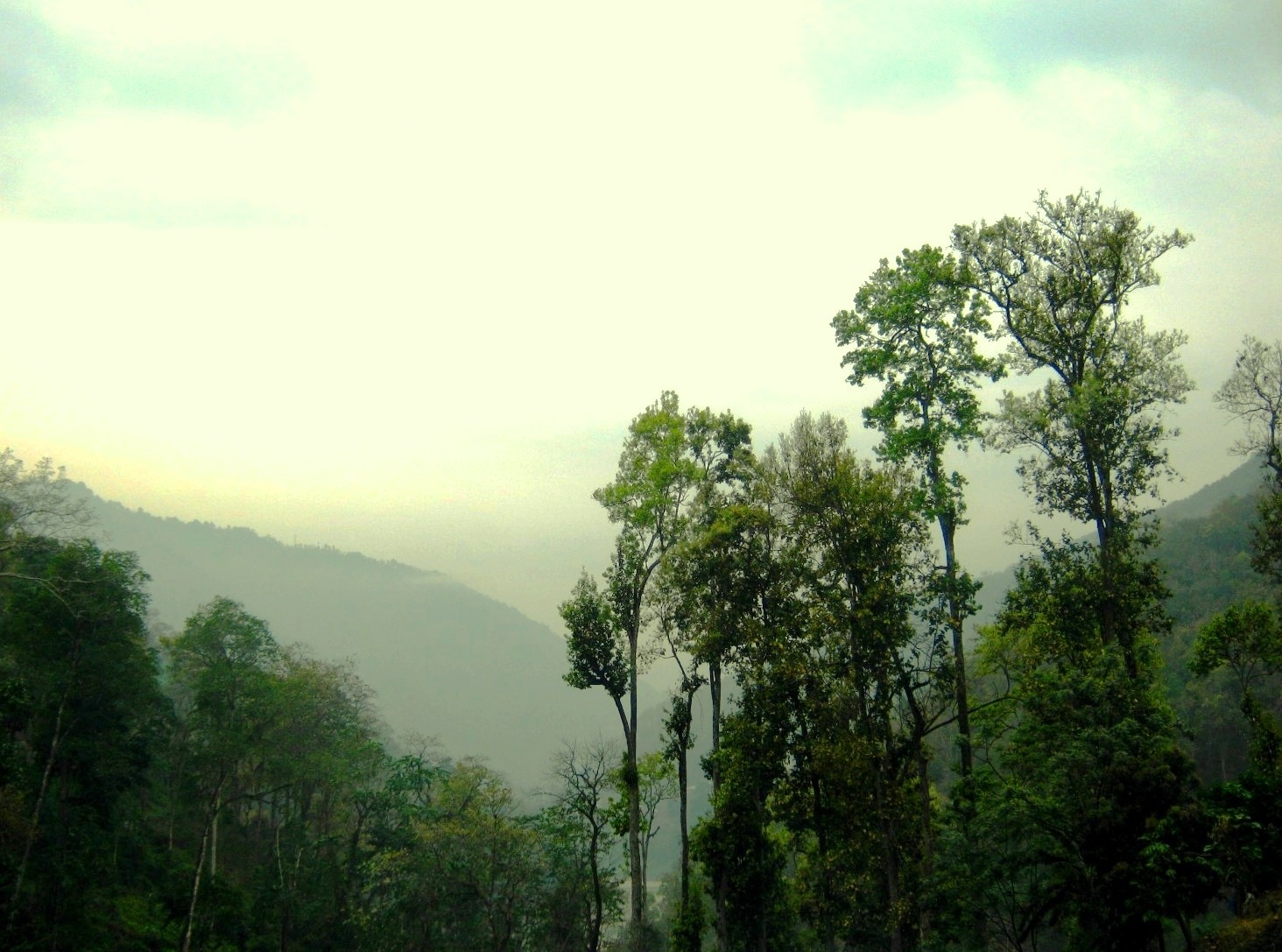
the forested mountain
We got up early in the morning, took an auto and got down at a place where the road was lined with shared vehicles that would take enthusiastic tourists to the hill town. It was tourism season at its peak but the roads had a deserted look maybe because we had arrived too early. Moreover, most tourists now head for Gangtok instead to avoid the rush at Darjeeling and the fear of strikes that GJM calls at the drop of a hat. We had to wait for quite a while before our vehicle, a TATA Sumo, headed for the fabled town. Our anticipation grew as the four-wheeler paced its way amidst sleepy homes and the parallel running 6 feet narrow gauge rail track, telling stories, out loud, of an era that had gone by. The Toy Train, hauled by steam engines, one of the oldest in operation in the world, no more plies from Siliguri but from Ghoom.

on the way to darjeeling
It wasn’t long before we left the plains and bypassing the many enormously huge and beautiful tea gardens spread all around came to Sukna, the mouth of the Mahananda WS, one of the most famous forest expanses housing exotic Himalayan animals. The tea gardens beyond it looked even more amazing and were reminiscent of the ones I had seen in the Brahmaputra valley of Assam. The tarmac road running in the middle of a forest opening to a stretch of lustful tea gardens with a riot of colors spread like a splash of green by a painter on his canvas looked awesome. It was one of the most amazing sights of the entire journey.

view from hooker road
Sukna had a small military cantonment owing to which the surrounding areas were smacking clean. The huge and lofty rocks of Mahabharata range, a part of Lesser Himalayas, rose abruptly from the plains of Darjeeling traversed by the rivers Mahananda and its tributaries. What didn’t change was the continuum of the tea gardens and the lush green forest. Darjeeling is one of the few places in the world which grows tea right from the plains to high up in the Himalayas at altitudes greater than 2000 m and has acquired a fame that culminated in it getting the only Geographical Indicator in India.

darjeeling railway station, 2200 m
Unlike in Arunachal where the Himalaya rose gradually, the rise was quite steep in this part of the world. The small towns and villages dotting the forested hills could be seen clearly and with abated tiredness despite lack of sleep we continued on our journey. Passengers kept on moving in and out but we had to go right till the end. Vivek, my friend, slept for most of the journey till Tindharia, a sleepy hamlet and one of the stations of the hill railway. It wasn’t long before we came across Kurseong, a major town in the district.

road to darjeeling
The famed Eagle’s Crag and the Television tower was visible from quite far away but I could not take pictures because of the restless driver who wouldn’t even stop to let us pee. We passed along many towns, small and medium, including Tung, Sonada, Jorebunglow and Ghoom before reaching Darjeeling at about 11 in the morning. The deserted railway track and the rapid population explosion which had resulted in environmental defoliation were visible quite apparently and said a sorry tale. Jorebunglow was the town from where an uphill road took one to the famed Tiger Hill but that was to happen later in the journey. Ghoom, the penultimate station of the Darjeeling Himalayan railway is allegedly the highest railway station in India and as we passed the dusty and misty town we could see a steam engine readying itself to haul a bunch of enthusiastic passengers who, I knew, would lose their cameras on a clicking spree at the Batasia loop. A journey, about which I had read and felt so much, was unfolding at a steady pace and seeing all that I had so far only visualized was a delight in itself and quite unparalleled in the world.

war memorial at batasia loop
Near the famed Ghoom monastery flanked by the hillock that had the War Memorial at Batasia we saw a bike rally of Gorkhaland Janmukti Morcha (GJM). The town has gained widespread notoriety and infamy owing to the unmindful hartals called by GJM and you never know if you are the unlucky one to bear the misfortune of being stuck up in one such hartal that brazenly runs for as long as one month. Though, by and large, tourists have never faced much problem in the hill district, inconvenience cannot be ruled out totally. Tourism, as such is the backbone of the district and strikes, small or big, only affect the localities, more than anyone else. Most people have become wary of it and the participation in the rallies is more out of compulsion than choice. Darjeeling, since the beginning of the 20th century, has been crying for a separate state owing to the indifference and apathy of Bengal government towards their origin and problems. Their demand, which is rightfully justified, has nonetheless never really risen to the challenge for reasons aplenty. The Darjeeling Gorkha Hill Council, which was a result of a protest wave gone violent in the late 1980s, had been much of a disaster and things are back to status quo.

inside the ghoom monastery
I have this bad habit of wavering in uncharted territories so back to what this blog is all about. It was afternoon when we reached Darjeeling and a personal achievement of sorts, a dream come true. The air had a harrowing chill and the uncountable flags of GJM could easily be mistaken for Buddhist prayer flags. Now was the time to look for the hotel. We asked for directions and taking an uphill road amidst a seething crowd of Indians and foreigners alike we reached the road that led to our hotel and also to Chowrasta, which was hardly a couple of steps from our hotel. I tasted some chhurpi (smoked cheese made of yak and cattle milk) and though it was as hard as stone, anything to chew in the biting cold was good enough. It was already time for lunch and we hadn’t eaten a morsel since morning. We got into a restaurant and had some luchi and aloo dum and a hot cup of Darjeeling tea. That was special because it was the first time ever I tasted the Champagne of Teas.

view from the hotel room
We reached the hotel reception and asked for our room. It was a nice heritage hotel with exquisite wood work giving it a colonial look which it certainly was. I asked the lady caretaker since when the hotel had been functioning to which she replied, “I have no exact idea but definitely since the British era.” We were quite surprised when we entered the room. It had a royal look and one of the windows directly opened to a stunning view of the valley and the hills. On a clear day one could, am sure, see the mighty Himalayan peaks but today was no such lucky day. A tuft of cool air blew in as I opened the window. I could see a mosque nearby and the muezzin was calling out loud to assemble the faithful. Closing the window and wiping the mist that had collected on the glass panes I could behold an amazing sight.

such classic symbolism
We rested for a while, took a light bath and rushed for Chowrasta. We had to see the Padmaja Naidu Himalayan Zoological Park which had a good assortment of Himalayan flora and fauna and the Himalayan Mountaineering Institute (both located in the same campus). The first sight of the very famed Chowrasta was marvelous. We could see families from far and wide cuddled together and having adda over hot cups of tea. Children rode ponies and the elderly sat in closed groups with a disturbing silence. Young people like us paced around in frenzied steps looking for alternatives. It’s always a case of, “What next?” with us. We took a road that went straight to the zoo. It was a memorable walk and one of the highlights of the journey. The Windamere and Mayfair hotels, one of the most popular in the town laid on the way. We also came across a huge auditorium where they conducted cultural events and saw the Raj Bhawan too, where the governor of West Bengal comes for a week or so during the summer. It was a beautiful and clean city, contrary to what I had been hearing all along from people in the plains.

inside hot simulating cafe
We had hardly walked a kilometer when we bumped across a café, Hot Simulating Café, a very tiny one and decided to sip a cup of tea. We had enough time and wanted to let ourselves lose in the flow of the moment. We hadn't got used to the mild taste of Darjeeling tea quite yet but it was about the occasion and not just the tea. A bunch of foreigners were having a great time laughing their hearts out. Songs of Bob Marley filled the air and hundreds of his pictures were stuck on a wall board. It was definitely an amazing place to be and we were enjoying every bit of our stay there. We headed for the zoo after that. It was a long and easy walk with the Observatory Hill on one side lined with ancient buildings and huge trees and the vast expanse of the sky on the other from where you could see the town enveloped in a hazy blue mist.

himalayan wolf (critically endangered)
The zoo was clean and very well managed. The entry fee was nominal and that included the HMI fare too. We got to see quite a bountiful of animals which we had never seen in real including the Snow Leopard, the Himalayan Black Bear, the Himalayan Wolf, the Himalayan Civet and the famous Red Panda besides a host of other animals and birds. The Himalayan Monyal and the Slow Loris were elusive while the Himalayan Salamander had gone into hibernation. The museum at HMI was pretty impressive. It was established by Tenzing Norgay after his successful attempt of Everest with the blessings of Nehru. It had an inspiring collection of stories, photographs and memorabilia from the many expeditions carried by renowned mountaineers in the Himalayas. By the time we got out it was about to be dark so we bunked the idea of visiting the Gombu Rock.

statue of tenzing norgay outside HMI
It was only around 4 in the evening but it gets dark quite early in the hills and moreover it was winter. We had a meal of omelet sandwich and some pakoras and headed for Chowrasta via the Singamari road. The sun was going down slowly spreading its crimson rays through the clouds and presented a beautiful picture. The whole town would soon be engulfed in darkness and we hurried our steps. We had walked enough for the day so we hired a jeep and headed for the main bazaar. We thought of going to the Peace Pagoda but someone told it will take quite some time so we skipped the idea and headed for our hotel. We bought some woolens and some memorabilia including a Japanese fan, a painting and a khukri which I had desperately wanted for myself. The night was getting colder and unbearable and we needed to get warm for sure.

the city under a blue misty veil
We headed for Chowrasta and got a bottle of vodka and took some gulps down our throat. Now was the time for Glenary. It was Christmas Eve and the restaurants were full of people making merry. We had a cup of tea and some eatables from the bakery and went down to the basement at Buzz. It was empty compared to the bakery above. A couple engaged in wild smooching didn’t mind our presence. We had some noodles and soup and went back to our hotel. It was one of the most popular bars in the town and quite a colorful one at that. We had a few more pegs of vodka and decided to call it a day.

freezing cold it was
It was a difficult night with the temperatures dropping below zero but we woke up with the same energy we had started our journey with. It was another freezing day but thankfully the geyser was working fine and the tap water warm. We have a habit of getting up very early when out of the homely comforts. We had decided to skip the pleasure of beholding the sunrise from Tiger Hill and see things at our own pace. We had our morning cup of tea and headed for a clock tower which we could see at a stone’s throw distance. It was majestic albeit crumbling. A poster by some local club said it was under renovation.

darjeeling peace pagoda
We hired a cab to take us around because walking to all the places worth a visit was just not possible. For 700 bucks (bargained down from the original 1200 the driver had asked for) a three point visit didn’t look bad and more so considering the second point was the distant Tiger Hill. First it was the majestic Peace Pagoda and the Nipponzan Myohoji Japanese temple where the Buddhist monk Nichidatsu Fujii had stayed for quite a while. The spiritual leader was very close to Mahatma Gandhi and quite a few of bapu’s letters and works were there in the temple. The Peace Pagoda was quite an imposing structure. It was cluttering cold and we struggled with our naked legs on the cold concrete stairs of the pagoda. We left the place for Tiger Hill via Batasia, Ghoom and Jorebunglow.

senchal lake
It took us almost half an hour to reach the place and it was such a pleasant journey. We passed across the Senchal WS which looked straight out from the heavenly pictures we see in our dreams. The dense cluster of trees, the chirping birds, the bushy mountains, and the sun burnt brown fields gave a surreal look to the place. We were enjoying every bit of our stay in the hilly town but were quite disappointed when we finally reached Tiger Hill. At a height of around 2500 m, it was highest hill in the area and on clear days one could see the Kangchendzonga and even the Everest from there and that too from the naked eyes but we weren’t that lucky today (thanks to the blanket of clouds and mist).

motifs from buddha's life at peace pagoda
But we could see Darjeeling on a hillock engulfed in a thick veil of fog and believe me if not for that the visit to Tiger Hill wouldn’t have been worthy enough. We had a cup of tea going downhill and saw the beautiful Senchal Lake, which supplied most of Darjeeling’s potable water. We halted next at the Ghoom monastery, not the biggest but certainly the most famous in the area. Next was the Batasai loop where you had the War Memorial and the loop where the Toy Train takes a stupendous turn and has been a topic of much fantastic lore. We were lucky to see the Toy Train zoom past us making a continuous hoot and bellowing a thick plume of black smoke. Our driver insisted we go to the Rock Garden and the Ganga Maya Park but asked for 800 bucks more. We decided to skip that and headed for our hotel instead. I was never fond of parks so didn’t mind missing it but for the small waterfall it had. On our way the driver showed us the Ava Art Gallery and the Rink Mall, Darjeeling’s only multiplex and hypermarket.

ava art gallery
We had our breakfast at a Marwari restaurant and even bought some green and black Darjeeling tea. We still had the time of the world but seeing a movie was never in our mind. We headed for the Mahakal Temple located near Chowrasta on the Observatory Hill and it was quite a task to get to the top. There was a small dark cave which had a Shiva shrine where for the alleged sin I did (tearing away a postcard of the fake Sathya Sai Baba) I got a big scratch on my glares and a bump on my head. There was a Kali temple and another unique temple nearby having both a Shiva and a Buddha idol. Pilgrims of both the religions had gathered in huge numbers and it was a real feast for the eyes to see such harmony. All done but the Gombu Rock was still left so we took the Hooker Road and headed straight for it. We again had a brief stopover at the Hot Simulating Café were a couple cracking odd Rajnikanth jokes got on our nerves and we left soon.

senchal wildlife sanctuary
We reached the zoo and took a straight deserted road for the rock. The journey seemed never ending. Whoever we asked said the same thing, “Go straight for another ten minutes” but the rock was nowhere to be seen. We finally got down to Singamari Road at North Point and were amazed that we had actually reached St. Joseph’s School, which was very impressive to say the least. The Darjeeling ropeway, the first in India (1968-2003), was nearby but was inoperative owing to a tragic accident in 2003 that killed four tourists. It went straight down the road to a tea estate notorious for its goons, as the locals said. The elusive Gombu rock was nearby and we thanked our lords that we could finally see it. It was quite amazing and impressive but we decided not to give it a try. We hired a car and got down straight at the main bazaar and from there rushed to our hotel. It was about to be dark and our energy at an all time low. We had seen the city and almost everything else it had to offer and were a satisfied lot.

curvy roads
I personally was very tired after the whole day’s rush and decided to sleep for a while before going to celebrate Christmas at some restaurant but laziness took over. The freezing temperature made vodka necessary so we headed for Chowrasta again and got some tinned sardines too. We had a couple of pegs and slept again and woke up reluctantly for dinner. Buzz was reserved and all the restaurants jam packed with tourists, mostly foreigners so we had to look for one where we could eat something. We finally got one where a nondescript dosa was served. We rushed back to our hotel, downed a couple of pegs more and decided to sleep for good. The cold was unbearable and the whole night I kept on shivering and turning from one side to another. It was perhaps the coldest night of my life.

inside our hotel
The next morning, 27th December, we went to Chowrasta for one last item, had Darjeeling tea for one last item, sat for a while, bathed under the sun and decided to leave for Makaibari tea estate, a few miles ahead of Kurseong, owned by Mr Rajah Banerjee. We reached quite in time and since Mr Banerjee was out in his tea garden we waited at his office. One of his caretakers showed us around the factory but since it was off-season we couldn’t see much. In another hour or so, bypassing the beautiful and lush hilly forests and the tea leaves we reached Siliguri and finally New Jalpaiguri. We still had enough time for our train so we ate and rested at a hotel and finally in the evening went to the station, got into our train and off to home. We reached Dakshineshwar early the next morning and reached home quite in time and after having a bath left for office to continue with the usual dal-chawal zindagi.

18 December 2010

arunachal pradesh

place: bhalukpong, bomdila, dirang, jang, tawang
district: west kameng, tawang
state: arunachal pradesh
location: tawang is some 350 km from tezpur via shuttle or bus
average cost per head: coming soon (in a group of four)
mode of transportation: shuttle, bus
stay: hotel hornbill (bhalukpong), yatri niwas (bomdila, 03782223005), hotel gan chin (tawang, 9436692465, 9436674585)
food: local and continental
fame: culture, tribes, monasteries, wildlife, river kameng, wildlife, himalays, passes, lakes etc

TOUR OPERATORS:

Himalayan Holidays (Tezpur-Bomdila-Tawang) 9436228628, 03794223151, 03794222483 (tawang office), 03782222017 (bomdila office), 9864364153, 9957178796 (tezpur office)
Shangri La Tours and Travels (Bomdila-Tawang, Bomdila-Tezpur) 03782222433, 03782223151, 03782222255, 9402232009, 9402241029

prayer flags: a constant companion
It was the night of 17th October, a night that was never to be but a night which made us realize what “in the middle of a moonlit night” actually was. A night of fervor, a night of chill, passion and I would go on to say my best bight ever. The quaint little town of Bhalukpong was never really in our plan. We were supposed to have headed straight for Bomdila on the morning of 18th but then as fate would have it, due to unavailability of regular shuttle from Tezpur we had to make decisions in haste and landed up in the town of Bhalukpong where a huge concrete head of Mithun, Arunachal’s state animal, welcomed us with its imposing colossal horns. We were told by the driver who had dropped us till there that we would get regular shuttle and buses for Bomdila. It was our folly we believed him but then we hardly had any other option. There was of course no one ready to drop us till Bomdila and we were left stranded in a place where everything was dark and reminiscent of Stone Age. In any case, a trip towards Bomdila, making way through serpentine hill roads, with valleys and ravines plunging deep into heaven didn’t sound good and we better gave it a miss and thought deciding the future of the trip the next morning. We paced ahead for hunting a hotel to hide our heads from the ravaging cold. There were hardly a couple of hotels there and we luckily found one, Hotel Hornbill, named after an exotic bird, the one that had till yet eluded us with its mystic stories and fame. We had countless cups of tea and then set along to scout for alternatives of reaching Bomdila the next morning. But before that we thought of taking an uphill walk. The night, with its expanse of the dark sky, the shining shield of the moon and the lofty hills, gave a surreal feel to our very own existence. We felt we were in a different world altogether. The military man, walking with hurried pace, made us realize of the ground realities, but nothing, absolutely nothing, made us feel, not even once, that we were in a piece of land which China laid claim on. It was every bit of India with beautiful Indians all around. I had fallen in love with Arunachal and it was to grow manifolds in the days to come.

welcome to the land of morning sun: bhalukpong
When every discussion with each shuttle owner and tour operator came to unhealthy conclusions we decided to rope in the help of a hawaldar of Arunachal Police. There was this fat and grumpy man, Mr. Pandey, from Purvanchal region of Uttar Pradesh (the fact that I am also a native of the same geographical region can’t be overlooked) whom we stalked for help as hapless college students with faces made to appear even worse than the war-ravaged people of Germany post World War II. I don’t know what made some of us register themselves as penniless college students out on a fun tour of the wild Indian hills but it was great fun faking identity. The man, a divine intervention for sure, took pity on us and decided to help, but not before long, out came all the stories he had baked in his heart. He was definitely hell-bent to help us out of the place but then, if you have forgotten, everything comes for a price. He was a lonely man, from the Gangetic plains of Uttar Pradesh who had his family living miles away. He had his tales of surprise, agony, happiness, content and disbelief. He narrated out his heart and we lent a patient ear. He had issues with his elder son, who had married a thick-lipped lady from South Africa, and paid little heed to the sacrifices of the old man. His younger son, studying in an upfront engineering institute had backlogs in his papers and that worried the old man who had plans of opening a school in his native village post retirement. The more he laid out his stories, to four complete strangers, the more conspicuous we became. We did sympathize with the man after all. In a matter of few hours, we knew each other well enough. He knew our villages, our schools, colleges and offices and we knew even his salary. It was getting late in the night so we left for our hotel (relax! the hotel was just on the other side of the road. Bhalukpong is a small town, with shops and hotels lined on a small stretch of the highway with some villages down the valley where a large board proudly gave directions to the Pakke Tiger Reserve) and with a couple of pegs of Vodka slept blissfully in the coy comfort of the narrow bed with Vivek beside me taking a zillion turns every second.

pakke (pakhui) tiger reserve
We woke up early anticipating the planning we had to do and to catch a glimpse of the rising sun but the hills at the distant and almost everywhere else made the sun elusive when it rose. Over cups of tea and a gentle breeze blowing in the Dooars I thought to myself, “Could life had taken a better turn?” and then I was hit hard with reality. The tour operators whom Mr. Pandey had given polite orders the previous night to arrange for our trip to Bomdila refused coldly citing unavailability of seats. Before we could get further disillusioned with the way things were going Mr. Pandey came on the scene, out of his small home, and assured us that he would arrange for something. Over more cups of tea and with a growing uneasiness and anxiety and with posters of Toko Teji nailed all around came the news from Mr. Pandey that he had, at last, arranged for a truck (headed for the McMohan Line) which would give us a lift. We were more than happy and puffed with a sudden splurge of excitement gasping the fact that we would finally be on our way to Bomdila and that too in a truck (besides the uncertainty of the days to come). We couldn’t thank Mr. Pandey any less for his noble efforts and for all what he did. We set off for the headquarters of West Kameng district with the gusto of a teenager.

tipi falls, tipi, west kameng
Arunachal came alive within minutes of the journey. The huge layers of forested hills, arranged one over the another, the wild and fast flowing river Kameng, the deep valleys, the muddy roads, the countless waterfalls, the small sleepy towns passing by, gibbons jumping from one tree to another in a dense clout of jungle on the other bank of the river would stuff excitement even in the weirdest of souls. It was getting too much to handle. The road was a botheration for quite a while since an expansion projection was underway by Border Road Organization (one of the most reputed bodies responsible for making roads in the most inhospitable of conditions and notorious for the road signs that range from salutes to the ones who died making the roads to be careful and cautious on the roads itself). The beauty of the land of many tribes kept unfolding at a leisurely pace. All along the journey, river Kameng was a constant companion. At places it was wide, muddy and looked wild and at others swift, white, rocky and narrow but with an everlasting beauty that would inspire the laziest of person to jump to action. Countless Bailey bridges along the river, hundreds of military outposts (which implies how critical this area is) and thousands of sign posts we left behind before halting at Nag Mandir Bazaar where we had a feisty lunch of local Arunachal food (a simple assortment of roti, dal, omelette, salad and some local vegetable cooked in little oil and spice) followed by a huge peach, the cultivar of which you would never get in the huge cities.

nag mandir bazaar, west kameng
A few miles hence we halted yet again for a dekho of the river Kameng where it had the biggest of the boulders in her belly. The truck journey, a first for us, was both exciting and tiring and after almost six hours we reached our destination for the day, Bomdila. I have no words to describe the beauty of the place. The closer we reached the place the more it looked like a gateway to heaven, the elusive Shangri La, which Arunachal has in abundance. It’s beyond my potential to paint the place with words with all the narrow roads, the multitude of hills of varying height, the hanging clouds, dark and white, the gorges and the constant chill in the air. The approach to Bomdila, I would say, was one of the highlights of the journey. A little drizzle had left the place unexplainably cold. We reached the place by 2 PM and straddling across the curvy roads of the town, which went up and down, finally reached our hotel, Yatri Niwas. Before anything else, we decided to book a vehicle that would take us to Tawang the next day but as expected every tour operator (there were four that I could count) raised their hands helplessly and said a big, “I am sorry. We are booked for the next few weeks.” The ambiguity of going to Tawang the next day mixed with the fact that even if we decided to turn back to Tezpur we would have no vehicle for days and maybe weeks made the whole episode sullen and bleak. But we were optimistic souls and after dousing the anxiety over a cup of tea left for discovering the town, a small one, but really difficult to cover owing to the terrain.

bomdila, 2217m, west kameng
A small gompa (stupa, chorten), which we could see from the road near our hotel, was marked as the destination and since it was about to be dark we hurried our steps. Going around the town, littered with butterflies in hues of the rainbow, birds unknown in the plains, dogs with a rich coat of fur, and the beautiful Monpa people made us realize that life out here is so difficult, so different, so close to nature and so celestial. A small town nestled deep in the lap of the mighty Himalayas, hundreds of miles away from the plains, is surely God’s own place. With heavy breaths and visible tiredness after having scaled the ascent to the stupa we felt blessed for having coming at least this far. The monks served us water in little porcelain cups and I tell you, water never tasted any better. Such innocence, such naivety, such playfulness, such nobility is very rare in the big cities. We retuned back to our hotel and since it was already dark we decided to dine at the best restaurant out there that would serve us authentic Arunachal food and settled for Hotel Tsepal Yangjom where we had thupka (a noodle dish with much gravy and enough to fill your stomach), manchow soup, rice and chicken manchurian. We asked the waiter if he could help arrange a vehicle for Tawang the next morning to which he gave an ambiguous reply, “I will try arranging some.” That did give us some solace and before retiring to our hotel for what we thought would be the last night at Arunachal gave our last words to the hotel manager, “It would be very kind if you could arrange something.”

(prashant) on the rocks! river kameng
Disillusioned despite the pleasure we had for the day we got into the comforts of our blanket and readied for sleep with just one peg of Antiquity Blue. It just wasn’t the right time to celebrate with rivers full of alcohol. A huge knock on the door made us jump on our feet. You certainly don’t expect guests, late in the night, in a stranger city and that too in the middle of Himalayas. We opened the door and in came a man, short and fair, with two mobile totting guys behind him. He told us he had been sent by the hotel manager who was his brother-in-law and that he was there to help us arrange a vehicle. To our dismay he continued with his blabber for the next half an hour saying how honest and god fearing he was and that he had a baby boy and a god-fearing wife whom he wouldn’t be able to show his face if at all he cheats helpless tourists. Without our approval he went on with his stories of how he charged nominal, that his Suzuki Eeon was brand new, just fifteen days old and how he would double up as a guide and show us every landmark place between Bomdila and Tawang including the Dirang hot spring, Sela Pass, Paradise Lake, War Memorial at Jaswant Garh and Nuranang Falls. He said he had this good habit of waking up early in the morning and circling the local gompa and that we could trust him and the price he would quote would be nominal, which was obviously, according to him, disregarding the fact that we were stranded tourists looking for a way out. He said he was notorious in the area as Chota Don and that people were afraid of him and that he was a true Monpa, fearless, god-fearing and honest. And finally when he came with his right price we all looked for cover. For a journey till Tawang he asked for 8000 bucks and when we said we had to return to Tezpur too he was quick to add another 5000. So for a journey from Bomdila to Tawang and back to Tezpur he wanted 13,000 bucks which would otherwise cost us not more than 5000. We were left speechless and told him we would let him know the next morning. The moment he left with his heavy rants of God, honesty and the Monpas, which still echoed in our ears, we gave a hearty laugh at our agony.

dirang valley, west kameng
The next morning we again woke up early, this time not for the rising sun but to linger around the tour operator’s office to ensure he arranges for some seat to Tawang. But everyone had the same clichéd answer, “It’s just next to impossible to arrange for a group of four. If at all anyone doesn’t show up it would still be a couple of seats and not four.” After much effort and wait, when most of the vehicles left for Tawang, fully loaded with all the passengers turning up, we decided to go and have a cup of tea and plan for the return journey whose prospects looked as bleak as anything else. We were, at that time, the four saddest people on earth. Things looked lost and forlorn and the very thought that we would miss so much gave us goosebumps. But then as fate would have it, amidst the entire petrol, cash and vehicle crisis, a local Omni driver, who had come for refueling, came to our rescue. The tour operator (Shangri La Tours and Travelers) was kind enough to fix the Omni for us and even went around looking for us after we had left for another cup of morning tea to douse the misery of having messed up everything. Our excitement knew no bounds at the godly news. We rushed to our hotels, packed our luggage and off for the holy town of Tawang which was in news on the onset of the year for the 14th Dalai Lama’s visit to Tawang monastery. His visit was a political message of sorts for China, that he very much considered Tawang, and the whole of Arunachal for that matter, a part of India. A few miles ahead, still in disbelief that we were actually heading for Tawang, we saw the mighty massif of Gorichen, housing the highest peaks of the state. The road was bad and dangerous but we had the will of iron and continued amidst beauty and a road lined with hillocks on one side and deep plunging valleys on the other.

bomdila, west kamneg
The first stop was the hot spring at Dirang but more than that I loved the Dirang Valley, all green and tempting and could see many campers there near the Dirang River. We had our breakfast at the town of Dirang and for a change the ATM was working fine there unlike at Bomdila. We headed further deep and high into the lap of the mighty mountain range and wherever we laid our eyes we could see eternal bliss including butterflies, birds, rivers, valleys, forested hills, and tribesmen in their strange dresses but with an ever smiling face. The man behind the steering was a thorough gentleman who helped me remember the hotel we had booked. My phone wasn’t working so I had no idea how to contact the hotel owner and confirm of our arrival plus I wasn’t getting the paper were I had written the name of the hotel. Bypassing some of the most stunning views I had ever seen in my life and many a munching herd of yaks we reached Sela Pass, the highest motorable road in North East. It was the first time ever I had been beyond 4000 m and the feeling gave me a high.

nuranang (jang) falls, jang, tawang
The roads looked more treacherous than ever before and we even saw the remains of a truck that had met a sad fate last year. There was a marked change in the hill topography with the rocks covered in colorful mosses and lichens and the air becoming thinner and to top it all, to our ultimate surprise, it began to snow. Yes, the 19th of October, it was the first snow of the season at Sela and my first ever. We jumped out of our car and couldn’t control our excitement and like kids left to play after the rigors of tuitions played and frolicked in the snow and the blowing cold wind. I took off my shirt and with just a vest on my body pranced around and could hear the aunties from my home state Bengal quip with anger, “Chele ta ke dekh, koto osobbho. Thanda lege gele bujhbe. Aaj kal kar chele ra! Shudu style.” (Look at that guy? How silly! He will understand when he catches cold. The guys of today! Too much style) There was a small gompa and an equally small shop nearby which served tea, maggi and other confectionery items. The beautiful lady owner was visibly upset over the sudden splurge of tourists who had come inside to protect them from the snow. We had countless cups of tea and when the wait for the obscure maggi became longer decided to move on with the displeased owner constantly shouting at the tourists to maintain discipline inside her shop and not taking eatables without her permission.

gorichen massif, as seen from bomdila
Just beyond the pass was Lake Paradise, one of the highest lakes in India and strikingly beautiful. The landscape changed as we went downhill with colorful coniferous trees replacing the evergreen mixed forests and the rivers becoming violent and rocky and more waterfalls along the route. We soon crossed the famed Jaswant Garh war memorial, erected to honor a brave soldier (Jaswant Singh Rawat) who was martyred in the 1962 Indo-Sino war and then the wait began for the ultimate adrenaline raiser, the Nuranang Falls, alternatively known as the Jang falls, located some miles off the town of Jang. It had come out of its oblivion in the year 1991 when a song of the movie Koyla was shot at the fall (and at the nearby Sangetser Lake).

sela pass, 4177m, the highest i have been so far
The terrain became rugged and forested again with much the same scenery we had left almost 350 km behind. It was getting darker and we waited with arrested breath for the fall and when it finally came we were left in awe. It was a sheer beauty, a gorge of water falling from a height no less than 300 ft and leaving a much higher imprint in our minds. Though we were in great hurry we did stop at the fall for quite a while and every single glance made us wonder how God has blessed this world with so much of plenty. We moved on and sometime later at a sharp turn we saw the first glimpse of the world’s second largest monastery and not before long, just before dusk, we reached our abode for the night, hotel Gang Chin in Old Market, Tawang. A local festival celebrating Dussehra was in full flow and they were serving butter tea and some snacks for free. The ATMs weren’t working in the city and there were long lines at STD booths and restaurants. We had yak momos for dinner and decided to participate in the road show which showcased an assortment of cultural fest from across Arunachal and Assam including the yak dance, a Bodo dance, a shawl dance, fashion show with wooden masks et al. It was great fun, a heady mix of global and local, of traditional and contemporary and to top it all, the MLA of the area was also there mixing with the crowd and handing away prizes as common as a slip draw. It was quite late when we went to sleep with a glass of brandy and woke fresh the next day for a trip to Tawang monastery and local sightseeing.

coniferous forests beyond sela pass
The monastery was really amazing, huge and colorful and markedly ancient with huge carpets hung on the wall, beautiful Buddhist motifs everywhere and the cylindrical bells that I had always wanted to churn around. A swarm of little monks, robed in red, came out running from the main temple and lined for breakfast. We too went inside the kitchen and asked to be served and they very much obliged. A visit to Urgelling Monastery, the birthplace of the 6th Dalai Lama and a war memorial rounded our trip after which began the most crucial part, the haggle for the return journey. Much like at every point of our journey in the Himalayan state we went around the town looking for alternatives but nowhere it seemed a viable option with reserved vehicles asking for as much as 17,000 bucks. We had our train to Kolkata the very next day from Guwahati so we had to, any cost, set forth today itself. After much struggle we got three seats (from much help of Himalayan Holidays) in an SUV which needed some urgent repair so we had to wait. The wait got longer and just when we started losing hope came the news that the car was ready. Finally, after much wait and with feelings mixed with anger, disinterest and indifference we headed for Tezpur and not before long the car had its breaks coming down and we had to wait for another couple of hours at Zero Point, Jang for our journey to resume. The driver had his hands bandaged and his pain was visible and with night falling quick and temperatures dropping considerably beyond Sela Pass he had to down his pain with a couple of pegs. It was an anxious night of uncertainty. We had our dinner at some dhaba in the dead of night and when it was obvious that the drunk driver would in no way be able to drive through the dangerous Himalayan roads any further we had to scout for another driver and luckily for us we got one in a car parked behind us at the dhaba. He was a minor but then he was the only one whom we could trust under such precarious condition because we had to move on lest we miss our train.

tawang monastery, tawang
It was around 2 in the night when we came across a huge traffic jam and the news that a landslide had occurred some feet away was yet another in the line of events our journey had so far shown us. The army had decided to blast the landslide and had requested me and Prashant to tell every vehicle in the hundred mile long line to push their vehicles back but the sleepy drivers paid no heed to our shouts so we decided to sit beside a waterfall and stare at the naked moon with dark spots and thought Arunachal was much the same. We moved ahead when the landslide cleared and with a sleepless night saw the dawn of a new day, our last day in the North East, at the Tipi falls, not far away from Bhalukpong. Moments later, we halted at the border town for tea, met and thanked Mr. Pandey for his help and moved on. We reached Guwahati, checked in a hotel, rested for a while, went to the zoo, a beautiful one, had dinner at a posh restaurant and finally two hours before midnight went to the station for our train that would mark the end of a journey, a wonderful one at that, to a conclusive end.

monks at tawang monastery
Despite all the ups and downs of the journey, despite all the uncertainty, despite all the anxiety, it was certainly the longest and most memorable journey of my life so far. I made new friends and got closer to the ones I had. Learnt so much about two most wonderful states of India, met people on the way who made me realize that it’s ultimately one big family we are all a part of. It’s one big beautiful world which has so much beauty to offer, to suffice for a lifetime and to protect which is the duty of every single soul. Till my next journey, this is Vivek Singh, signing off, and wanderlust till doomsday!